|
Administration and Policy Manual APM |
Doc No.: APM 1.3 Revision: 0 Date: 15Apr 2023 Issued by: DPA Approved by: MD Page: 1 |
1.3 Safety Management System (SMS)
The Safety Management System (SMS) applies to the Ship Management, Technical & Crewing Offices of Ship Management Company.
The system is written in compliance with:
- ISM Code - section 1.4, 2, 3, 4, 5
- ISO standards 9001
- SOLAS
- COSWP
- TMSA/OVMSA - section 1
- Other legal requirements
- Applicable codes, guidelines and standards recommended by IMO, Flag Administrations, Classification Societies and Maritime Industry Organizations
- Company policies on Quality, Health, Safety and Environment protection
The cornerstone of good safety management is commitment from the top. In matters of safety and pollution prevention, the commitment, competence, attitude, and motivation of individuals at all levels determine the result.
Safety and Quality are integral parts of our management. Good ship-shore teamwork results in safe and efficient operation of the vessel. Company manuals include instructions and procedures to achieve this objective.
The company encourages ship staff to provide suggestions for improving the standards of safety and quality on board. The contribution of every individual, however small, is the key to achieving success.
Top management is committed to:
- Development and implementation of 'Quality Management System'
- Continually improving its effectiveness
The guidelines given in Company manuals are not exhaustive and cannot cover every possible situation. Exercise common sense and good practice of seamanship besides complying with local laws and regulations.
Similarly, onboard ship, it is the Master’s responsibility to ensure that the officers and crew have adequate access to the procedures and are conversant with the relevant information in the system applicable to their rank or rating and that the system is fully complied with at all times.
Training, wherever possible, is to be given to seafarers ashore and may be supplemented by onboard training from time to time.
1.3.1 Scope
The SMS incorporates business, personnel and technical management and the execution of all activities deemed as vital in obtaining safety, environmental and quality performance in service and customer satisfaction.
Records maintained in DSM (Digital Ship Manager) application as per SMS processes, both in support and/or as substitutes for those carried in this SMS (even if not exact copies) will be regarded as compliant with the SMS.
1.3.2 Field of Application
The SMS applies to all critical activities executed by the Company, ashore and onboard. Activities performed on behalf of the Company by contractors and suppliers will be monitored accordingly. The Company requires that contractors and suppliers maintain a similar level of safety, environmental, and quality performance.
Where the Company delegates ISM and quality related tasks to external entities, an annual audit on these entities is required to ensure they are acting in conformity with the Company responsibilities under the standards the SMS is written in compliance with as detailed in section 1.3 of this chapter.
1.3.3 ISO Exclusions
The Company, as a provider of ship management, does not design and develop products and services relating to ships. Section 8.3 of ISO9001:2015 - Design and development is therefore not applicable for the services provided by the Company and are accordingly excluded from the SMS.
1.3.4 Process Approach
The SMS adopts a process approach to enhance customer satisfaction by meeting customer requirements. Understanding the interrelated processes contributes to the Company’s effectiveness and efficiency in achieving its intended results.
The process approach involves the systematic definition and management of processes using a “PDCA” cycle.
Plan:
Establish the objectives of the system and its processes and the resources needed to deliver results in accordance with customers' requirements and the Company’s policies. Identify and address risks and opportunities.
Do:
Implement what was planned.
Check:
Monitor and, where applicable, measure processes and the resulting products and services against policies, objectives, requirements, and planned activities. Report the results.
Act:
Take actions to improve performance, as necessary.
Plan-Do-Check-Act (PDCA) Cycle
Figure 1 – Schematic representation of the elements of a single process.
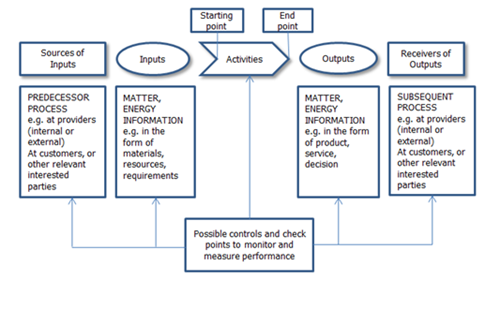
The PDCA cycle can be applied to all processes and to the quality management system as a whole. Above illustrates how Clauses 4 to 10 of ISO 9001 / 14001 can be grouped in relation to the PDCA cycle.
1.3.5 Best Practice
A best practice is a technique or methodology that, through experience and research, has proven to reliably lead to a desired result. Best practices take into account:
- Industry recommendations
- Lessons learned
Best practices are identified through new legislation, benchmarking, shore and vessel feedback and are promoted throughout the company through general communications and inclusion into the procedures.
1.3.6 SMS Training
The Company’s Safety Management System needs to be understood by all the sea and shore colleagues. All these manuals are easily accessible on board and office, and each team member must read and acknowledge the understanding of the Safety Management System.
Training in Safety Management System on board is the responsibility of the Master.
Training in Safety Management System in Office is the responsibility of HSSEQ Manager.
1.3.7 SMS Distribution
A complete set of all Safety Management Manuals is to be placed in the following areas:
- Head Office – Online link
- Manning Offices - Online link
- Onboard – Master’s Office – acts as server for onboard use
- Onboard – Ship’s Office – accessible via LAN network
Ship’s Office Safety Management Manuals should be readily accessible to all Ship Staff for their understanding of our company.
1.3.8 SMS Accessibility Onboard and Ashore
- The company uses a Web-based program as the custodian of all documents which is updated with the latest version of all documents.
- Offline access is made available to all vessels, which enables the user onboard the vessel to access the latest version of documents at all times regardless of internet connection.
- Online access is made available to all office staff, which enables users to access the latest version of documents only when the user is connected to the internet.
- Management has recognized unforeseen circumstances where office or vessel staff may not be able to access the latest version of documents. Therefore, a period of 30 days is permitted as a transition period where former versions can be accepted as compliance.
Following list of manuals/instructions are required in hard copies due to their nature of scope and other legal requirements:
- Bridge Procedures (Navigational procedures - FOM-3.0)
- All contingency matrices/appendices shall be maintained in a file on the bridge and to be kept up to date with vessel-specific information.